FINANZA/ Per salvare la Grecia, Francia e Germania affossano l’euro

giovedì 4 marzo 2010

Quando manca la chiarezza, manca tutto. Soprattutto quando si parla di economia. Cerchiamo, quindi, di farne un pochino in questi giorni di enorme incertezza. Primo, la Gran Bretagna non è la Grecia, anche se il dato del deficit su Pil al 12% è peggiore dei già sgangherati conti di Atene. In Gran Bretagna, infatti, i problemi sono diversi: c’è la resistenza dell’inflazione a cui è molto sensibile il mercato dei bond inglesi, c’è l’impatto di quei 200 miliardi di sterline pompati dalla Bank of England nel sistema ancora tutto da valutare, c’è il rischio di una svalutazione globale della sterlina che preoccupa soprattutto per via dell’esposizione del settore bancario e dei privati.

Ma non c’è, a differenza di Atene, un reale rischio sulla ristrutturazione del debito, ovvero la trappola su cui si scommette con i cds. Il perché è semplice: grazie a Dio gli inglesi non hanno l’euro e hanno ancora autonomia valutaria. Secondo punto, la speculazione che ha colpito negli ultimi giorni la sterlina - con scommesse aumentate del 10% in una settimana al Chicago Merchantile Exchange - è strutturale alla crisi politica interna: il rischio di una non maggioranza o, peggio, di un altro governo Brown tra settanta giorni quando si voterà, ha creato le condizioni affinché gli investitori si siano posti short sul pound.

Essendo però la Gran Bretagna un paese in cui la parola bene comune ha ancora un senso, da due giorni i LibDem, ovvero il terzo partito destinato a un ruolo fondamentale in caso di impasse alle urne, stanno rassicurando la City dicendo che non porranno in essere ricatti politici ma che collaboreranno con chiunque vincerà «in nome dell’interesse nazionale». Difficile immaginare Di Pietro o la Lega porsi in questa condizione di responsabilità.

Chi ha shortato il pound lo ha fatto sul breve, arraffa e scappa: la crisi dell’eurozona è altra cosa. E il perché è presto detto. Il mercato dei bond governativi, nei fatti, è il prossimo ciclone subprime: ci sono già tutti i presupposti affinché la bolla esploda, con grande gioia di chi giustamente scommette sulle incapacità - e non le disgrazie - altrui. Il punto fondamentale è infatti questo: per salvare Atene, ovvero per salvare gli interessi franco-tedeschi, l’Ue sta esponendo l’euro a un rischio speculativo potenzialmente devastante.

Vediamo come. L’altro giorno il commissario per il Mercato interno dell’Unione, Michael Bernier, ha così tuonato contro gli hedge funds e le loro scommesse sui cds legati al debito greco: «Io voglio sapere chi ha fatto cosa… Io voglio capire». Confortante il fatto che, a oggi, un uomo in quella posizione non abbia ancora capito cosa stia succedendo. Proviamo a spiegarglielo noi, utilizzando le parole dei portavoce di due fondi, Brevan Howard e Moore Capital: «Oggi come oggi per noi è piu’ sicuro scommettere contro l’intera area euro, contro la valuta comune, che contro un singolo Stato poiché i rischi regolatori nelle scommesse su posizioni di rischio individuale sono troppo grandi, anche alla luce della nuova regolamentazione che l’Ue intende mettere in campo».

Capito, quei geni di Bruxelles per tutelare la Grecia, o chi per essa in futuro, mettono l’euro nel mirino. E anche la favola dello speculatore cattivo deve finire: Brevan Howard, che conta un portafoglio di assets da 27 miliardi di dollari, ha solo posizioni contro l’euro, non contro la Grecia. Lo stesso vale per Moore Capital e per Paulson&Co, che infatti ha già smobilitato tutte le posizioni rispetto al debito di Atene. Chi sono, quindi, questi falchi che vogliono la distruzione della Grecia? Chi scommette short si lancia sull’euro, sicuro che se anche andrà in porto il piano da 25 miliardi di euro, la crisi sociale che rischia di divampare per le misure draconiane di riduzione del debito farà partire un effetto domino sui Pigs, con la Spagna pronta a finire nel mirino per un breve periodo.

Caro Bernier, non è difficile capire cosa stia succedendo, come vede. Nessuno di noi, per quanto possa voler bene al suo vicino di casa, rischierebbe il pignoramento dell’appartamento per salvare quello di un conoscente: bene, la Grecia paghi il prezzo dei suoi errori e tragga una lezione salutare, così come ha fatto l’Irlanda e l’Italia si faccia sentire in sede Ue al fianco di Londra (in fondo le due Borse sono fuse, perché non dovremmo ritenerci partner privilegiati?), poiché tedeschi e francesi puntano a privatizzare la crisi greca divenendo prestatori di prima istanza e, di fatto, controllori dell’Ue.

Anche perché la tensione nell’Ue rischia di salire e molto questo weekend, giorni in cui i cittadini islandesi saranno chiamati a pronunciarsi attraverso un referendum sull’opportunità per ognuno di loro di dover pagare 14mila euro di denaro pubblico, ovvero l’ammontare dei rimborsi chiesti dai governi britannico e olandese per il fallimento Icesave, scatola cinese di banking online che ha lasciato sul lastrico migliaia di correntisti, questi sì, ben poco avveduti.

Se Reykjavik dirà no la reazione di Londra, già innervosita dagli atteggiamenti franco-tedeschi nella gestione della crisi greca e dall’attacco alla sua valuta, sarà di quelle pesanti: ovvero a colpi di veti e minacce, nemmeno troppo velate. Una crisi interna tra i grandi player europei farebbe la gioia degli hedge funds, che vedrebbero le loro scommesse contro l’eurozona tramutarsi in una miniera d’oro basata sull’instabilità: e Londra, in nome della già citata autonomia valutaria, potrà godersi lo spettacolo dell’euro maltrattato dai fondi di mezzo mondo, certamente più “sicuri” nell’attaccare un’Unione che conta al suo interno Pigs e Club Med che un paese dall’alto debito ma senza problemi reali di ristrutturazione dello stesso. E, pronto in ultima istanza, a un opt out verso l’Efta.

Il buon Bernier, burocrate di prima nomina, questo non lo capisce, povera creatura. Se la Gran Bretagna ha un problema, questo non è rappresentato né dalla sterlina né dai cds ma dalla bomba Prudential, ovvero il colosso assicurativo che ha lanciato un’Opa da 35 miliardi di dollari sul ramo asiatico del big decaduto americano Aig: da due giorni il titolo Prud crolla miseramente in Borsa sui timori, di fondi e anche azionisti, che l’azzardo di non aver fissato in anticipo il numero di azioni da emettere nella rights issue di finanziamento - operazione che vede un’emissione extra di azioni destinata solo a chi ne è già detentore e a un prezzo scontato su quello del mark-to-market - porti a un deprezzamento eccessivo del titolo e renda la stessa Prudential a sua volta vittima di un takeover, cosa non improbabile.

Insomma, un passo molto più lungo della gamba, un’operazione finanziaria eccessivamente diluitiva a livello azionario che potrebbe creare un tonfo al titolo e un danno enorme all’azienda: se questo accadrà la bolla assicurativa che come un fantasma vaga per mesi in Europa, sarà pronta a esplodere. Già ieri in Borsa i dati poco confortanti sull’occupazione Usa hanno stranamente fatto crollare i titoli bancari europei, pensate cosa potrebbe accadere se Prudential vedesse il suo titolo a picco - lo short da parte dei fondi è già partito - e la sua stessa stabilità messa a rischio: il peggio, ancora una volta, sembra davanti a noi. Chiudere gli occhi, come fa il buon Bernier, non è ottimismo gramsciano ma irresponsabilità. Crassa.

http://www.ilsussidiario.net/News/Economia-e-Finanza/2010/3/4/FINANZA-Per-salvare-la-Grecia-Francia-e-Germania-affossano-l-euro/70564/

BERNSCONI

Ieri a Zurigo abbiamo avuto una bella giornata primaverile con sole e temperature piacevoli - stamattina ci siamo risvegliati con la neve. Tempo pazzerello! Ieri i mercati azionari europei si sono rafforzati mentre il rialzo in America si é bloccato. Stamattina si cambia direzione e si prevede un calo iniziale dell'1%. Borsa pazzerella?

Ieri le borse europee si sono ulteriormente rafforzate. A fine giornata abbiamo avuto plusvalenze tra il +0.7% e il +0.9% con un'acuto per il FTSE MIB (+1.46%). L'America é salita nella prima ora di contrattazioni abbastanza per risucchiare i mercati europei. Poi é riscivolata verso il basso e l'S&P500 ha chiuso invariato a 1118 punti. Lo slancio dei rialzisti sembra ora terminato e stamattina si profila una seduta negativa con perdite iniziali sull'1%. Tecnicamente la situazione é inariata e possiamo ripetere quanto scritto ieri mattina: "Abbiamo una situazione confusa con indici in ribasso (FTSE MIB), in bilico (Eurostoxx50), con segnale d'acquisto (DAX) ed in trend rialzista con nuovi massimi annuali (SMI). In America l'S&P500 ha guadagnato ancora alcuni punti ma é rimasto lontano dal massimo giornaliero e sembra aver esaurito la spinta verso l'alto. La situazione si presta a differenti interpretazioni. La più probabile resta l'inizio di una fase di rialzo a medio termine con obiettivo tra i 1150 ed i 1170 punti di S&P500. L'alternativa é un massimo discendente per venerdì e la formazione di una testa e spalla ribassista." Il cambio EUR/USD é salito a 1.3675. Il rialzo del dollaro dovrebbe nei prossimi mesi continuare in direzione del nostro obiettivo a 1.30 ma per ora dovrebbe fare una pausa. Un rimbalzo di alcune settimane verso gli 1.40 é probabile. L'oro é invariato a 1136 USD/oncia. Questa contemporaneo rafforzamento di dollaro e oro é inusuale e potrebbe segnare l'inizio di una nuova fase di forza del metallo giallo.

Leggete il nostro avviso o visitate il nuovo sito !!!

Passiamo ora ad esaminare la situazione (charts a sei mesi) dell'S&P500.

L'S&P500 (+0.04% a 1118 punti) é salito a 1125 punti nella prima ora di contrattazioni ma a questo punto la spinta dei compratori si é esaurita. L'indice é quindi tornato al punto di partenza e sotto la resistenza a 1120 punti. L'espansione dei nuovi massimi a 20 giorni a 2492 mostra però una sana partecipazione al rialzo. A corto termine l'indice é ipercomperato e dovrebbe consolidare. Il futuro é incerto e dipende da come l'indice arriva sul punto tornante del 6 di marzo. Un massimo discendente potrebbe mostrare una testa e spalle ribassista. La variante di un rialzo a medio termine descritta domenica resta una valida possibilità anche se un minimo per venerdì non é più realizzabile: "L'indice potrebbe avere ancora alcune deboli sedute e ridiscende sui 1085 punti. Prevediamo un minimo intorno al 6 di marzo e quindi queste dovrebbero essere le ultime possibilità per coprire short e preparare long prima dell'inizio di una nuova fase rialzista. (...) La prossima fase ha il potenziale di far risalire l'indice sui 1150 punti per un doppio massimo e top. Un'estensione fino ai 1170 punti é possibile."

Scenario 2010 Per i prossimi mesi prevediamo una sostanziale correzione delle borse dopo il rally di marzo - dicembre 2009. Probabilmento l'S&P500 toccherà nel corso di quest'anno un minimo tra i 740 ed i 820 punti. La performance annuale dovrebbe essere negativa e l'S&P500 dovrebbe terminare il 2010 intorno ai 900 punti. Gli analisti fondamentali stanno continuamente rivedendo le stime degli utili delle società. Ad un certo momento erano scesi fin sotto i 30 USD. Ora che la recessione sembra alle nostre spalle, le stime ufficiali per il 2009 (al 3 novembre 2009) sono risalite a 56.22 USD. Quelle per il 2010 sono addirittura al'incredibile livello di 74.99 USD. Capitalizzando gli utili 2009 con un P/E normale di 15/16 si arriva ad un valore teorico dell'S&P500 di 900 punti. In questi dati é però scontato un recupero marcato dell'economia ed un forte aumento degli utili delle imprese. Ricordiamoci che gli utili operativi 2008 delle società dell'S&P500 sono stati di 15.09 USD. Debitiamo inoltre che i dati relativi al 2010 siano realistici. Di conseguenze stimare ora correttamente gli utili delle società e determinare un giusto rapporto P/E per capitalizzare questo valore é un'impresa ardua. Troppe sono le variabili e le incognite. Se gli utili risalissero solo a 50 USD e la ripresa fosse anemica (come ritiene una buona parte degli economisti), un P/E di 12 sarebbe più adeguato portando il valore teorico dell'S&P500 a 600 USD. Riassumendo, tecnicamente e fondamentalmente i 1115 punti di S&P500 raggiunti a fine 2009 corrispondono secondo noi ad una sopravalutazione del mercato. La prossima dovuta sostanziale correzione ci dirà a quale punto si trova la congiuntura mondiale.

Richiedete informazioni a analisi_tecnica@longshortinvest.com Non rispondiamo a mails anonime.

Bernasconi Consult, gestione patrimoniale e consulenza finanziaria Rütistrasse 13, CH-8702 Zollikon Tel. +41 43 499 63 84 EMail: bernasconi@longshortinvest.com

Islanda, l’esodo figlio della crisi

Islanda, l’esodo  figlio della crisi Islanda, l’esodo figlio della crisi Quello che si sta verificando in Islanda è un vero e proprio esodo. Un esodo “finanziario”. Ma a partire non sono trader né manager, bensì gente comune...

Quello che si sta verificando in Islanda è un vero e proprio esodo. Un esodo “finanziario”. Ma a partire non sono trader né manager, bensì gente comune, impaurita dal crollo dell’economia domestica provocato dall’esplosione della bolla subprime. E, soprattutto, scoraggiata dalle prospettive future.

L’agenzia France-Presse racconta la storia di Anna Margret Bjarnadottir, ragazza madre di 46 anni che ha preso ormai la sua decisione: lascerà il Paese d’origine per trasferirsi in Norvegia. Una donna in più in un flusso di migranti che nell’isola di ghiaccio ha raggiunto le cifre più alte degli ultimi due secoli. «Non ho più un avvenire qui. Non c’è un futuro per questo Paese nei prossimi venti anni», ha spiegato la donna, che porterà con sé sua figlia. «Controvoglia e costretta», abbandonerà la sua casa a Mosfellsbaer, quindici chilometri da Reykjavik, dove viveva dal 2004.

Il crollo finanziario personale di Anna Margret è identico a quello di numerosi suoi connazionali, ed è legato ad un prestito in valuta estera (in yen e franchi svizzeri) consigliatole dalla banca nella quale aveva depositato i suoi risparmi , che è “esploso” a causa del crack della corona islandese. «Le mie rate sono raddoppiate, e non cesseranno di aumentare. Sono costretta a cercare fortuna altrove anche perché sono disoccupata da più di sei mesi - ha spiegato, sventolando i documenti bancari -. Non credo di poter offrire un futuro a mia figlia Olavia qui in Islanda».

http://www.valori.it/italian/finanza-globale.php?idnews=2103

Fake Tungsten Gold Found

Trace Mayer, J.D.

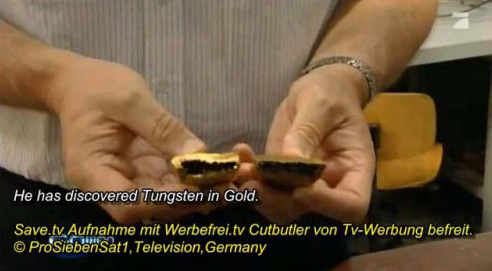
When one goes to buy gold they want real gold, not some cheap substitute like a fake tungsten gold bar. There has been a lot of rumor, neither credible nor verifiable sources, about bars containing both gold, the Ancient Metal of Kings and tungsten, the ‘heavy stone’.

Just like a $100 bill costs about $.04 to produce leading to a profit of $99.96 from such unethical currency production so likewise with the price of gold at $18,000 per pound and the price of tungsten around $25 per pound there is, for the unscrupulous, an opportunity for arbitrage.

GOLD PROPERTIES AND TUNGSTEN PROPERTIES

As Rayner Hesse observed on page 191 of Jewelry Making Through History, with the Stamp Act of 1854 the purity of gold jewelry was reduced and required to be hallmarked at 9k, 12k or 15k and so the search for gold alternatives began. Within a few decades the House of Cartier had gone international and Edward the VII named it the ‘Jeweler of Kings and King of Jewelers’. Presently, many watches are being made with tungsten carbide instead of gold because it is lightweight, takes a polish and is scratch resistant.

Gold has a density of 19.30 grams per cubic centimeter at room temprature and a liquid density at the melting point of 1,947.5°F of 17.31 grams per cubic centimeter. Tungsten has a density of 19.25 grams per cubic centimeter at room temprature and a liquid density of 17.6 grams per cubic centimeter at the melting point of 6,192°F.

But despite being used for jewelry and having similar densities gold, AU 79, and tungsten, W 74, are not the same element. But a 400 ounce bar with 1/16″ gold surrounding a tungsten slug would cost about $50,000 to make and would likely pass sound, feeling, chemical and weight tests along with an x-ray fluorescence scan. On the other hand, the higher profit margin $500 bar using small tungsten slugs with lead alloy would still pass a sound and feeling test but would be slightly underweight and it is likely that neither a chemical test nor a x-ray fluorescence test would be passed because the gold coating would not be thick enough.

HOW TO DETECT A FAKE TUNGSTEN GOLD BAR

Detecting a high-quality fake tungsten gold bar would be extremely difficult. It would likely require significant and material alterations to the bar being tested and this would negatively affect the marketability if its hallmark veracity were vindicated.

This is likely a reason why page Page 11 of the GLD prospectus states “Neither the Trustee nor the Custodian independently confirms the fineness of the gold allocated to the Trust in connection with the creation of a Basket [issuances].”

Nevertheless, the truly determined and experienced can ferret out whether there is tungsten contained in their gold bars. In fact, some already have found tungsten in bars which purport to be gold and this is how.

gold  refining

GOLD ALTERNATIVES

If one is concerned about the quality of their gold then the other precious metals like silver and platinum are good alternatives with the silver prices and platinum prices being strongly correlated with the gold price. One reason they are safer is because both silver and platinum have industrial applications and are widely consumed. The silver and platinum stock are rotated on a regular basis being melted down and fashioned into cell phones, catalytic converters, etc. and so the purity and integrity of the above ground stockpile is held to strict account because of physical demand market forces.

CONCLUSION

There is plenty of profit motive for fraudulent gold bars that are stuffed with tungsten. Imagine the pandemonium if the central banks not only had less than half the gold they claim but if of the gold they have the majority of it is filled with tungsten. Tungsten filled gold bars being ferreted out in Germany is disturbing. This is just another example of why to buy platinum or silver.

DISCLOSURES: Long physical gold, silver and platinum with no interest in the problematic SLV, Streettracks Gold ETF Trust Shares or the platinum ETFs.

Trace Mayer, J.D., author of The Great Credit Contraction holds a degree in Accounting, a law degree from California Western School of Law and studies the Austrian school of economics. He works as an entrepreneur, investor, journalist and monetary scientist. He is a strong advocate of the freedom of speech, a member of the Society of Professional Journalists and the San Diego County Bar Association. He has appeared on ABC, NBC, BNN, radio shows and presented at many investment conferences throughout the world. This is merely one article of 197 by Trace Mayer, J.D.

Latest Bill Gross minus the Bull

Luc Valée

I'll save you from Bill Gross social chatter in "Don't Care", his March outlook. He isn't good at it anyways. If you want to read that part, you can click here. Otherwise, carry on. And I am also not lying about the no bull business; the guy is a real bear. Yet, it all makes sense. As I said yesterday, it's all a question of timing. "Let's get reacquainted with the fundamental economic problem of our age - lack of global aggregate demand - and how we got to where we are today: (1) Twenty years of accelerated globalization incrementally undermined the real incomes of most developed countries' workers/citizens, forcing governments to promote leverage and asset price appreciation in order to fill in what is known as an "aggregate demand" gap - making sure that consumers keep buying things. When the private sector assumed too much debt and asset prices bubbled (think subprimes and houses, or dotcoms/NASDAQ 5000), American-style capitalism with its leverage, deregulation, and religious belief in lower and lower taxes reached a dead end. There was a willingness to keep on consuming, there just wasn't the wallet. Vigilantes - bond market or otherwise - took away the credit card like parents do with a mall-crazed teenager. (2) The cancellation of credit cards led to the Great Recession and private sector deleveraging, the beginning of government policy reregulation, and gradual deglobalization - a reversal of over 20 years of trade policies and free market orthodoxy. In order to get us out of the sinkhole and avoid another Great Depression, the visible fist of government stepped in to replace the invisible hand of Adam Smith. Short-term interest rates headed to 0% and monetary policies of central banks incorporated new measures labeled "quantitative easing," which essentially involved the writing of trillions of dollars of checks to replace the trillions of dollars of credit that disappeared after Lehman Brothers. In addition, government fiscal policies, in combination with declining revenues, led to double-digit deficits as a percentage of GDP in many countries, a condition unheard of since the Great Depression. (3) For awhile it seemed that all was well, that the government's checkbook could replace the private market's wallet and credit cards. Risk markets returned to normal P/Es as did interest rate spreads, and GDP growth resumed; it was only a matter of time before job growth would assure the world that we could believe in the tooth fairy again. Capitalism based on asset price appreciation was back. It would only be a matter of time before home prices followed stock prices higher and those refis and second mortgages would stuff our wallets once again. (4) Ah, but Dubai, Iceland, Ireland and recently Greece pointed to a potential flaw in the model. Shaking hands with the government was a brilliant strategy in 2009 when it was assumed that governments had an infinite capacity to leverage themselves. "But what if they didn't? What if, as Carmen Reinhart and Kenneth Rogoff have pointed out in their book, "This Time is Different," our modern era was similar to history over the past several centuries when financial crises led to sovereign defaults or at least uncomfortable economic growth environments where real GDP was subpar based on onerous debt levels - sovereign and private market alike. What if - to put it simply - you couldn't get out of a debt crisis by creating more debt? "You are now up-to-date and I've used up all of my 90 seconds, but bear with me, patient reader. I may not be able to get your kid a job at PIMCO, but maybe I could give you an idea or two as to what lies ahead. Let's explore the last line in the previous paragraph first - can you get out of a debt crisis by piling on another layer of debt? The answer, of course, is that "it depends." Replacing corporate and mortgage debt with a government checkbook is initially beneficial because the sovereign is assumed to be more creditworthy than its private market serfs. It taxes, it prints, it confiscates wealth if need be and so this substitution is medicinal in the early stages of a financial crisis aftermath - especially if debt/GDP levels are low to begin with. That is the case currently at most G7 countries, with the exception of Japan, although the balance sheets of Germany/France are obviously contaminated by its weaker EU members, and that of the U.S. by its Agencies and other off-balance-sheet liabilities. But based on existing deficit trends and the expectation that not much progress will be made in reducing them, markets are raising interest rates on sovereign debt issuance either in anticipation of higher future inflation, increased levels of credit risk, or both. This places a potential "cap" on the "debt" that supposedly can be created to get out of the "debt crisis." "The threat of credit deterioration is clearly evidenced in the CDS or credit default market for sovereign countries. Greece has taken the headlines with its 350-400 basis point cost of "protection," but even Japan and the U.K. approach 100 and the U.S. is nearly half of that. Markets, in fact, are demanding 20-30 basis points of higher insurance premiums for the best of credits relative to levels prior to Dubai and Greece. The inflation component of sovereign issuance is obvious as well. Potential serial reflators such as the U.K. and U.S. both show an increase of 50 basis points in their 10-year notes since the Dubai crisis in late November. While a portion of that 50 may in fact be credit related as pointed out above, the combination of credit and inflationary protection demanded by the market suggests, as Reinhart and Rogoff point out in their book, that government securities following a financial crisis are subject to huge increases in supply and accordingly, significant increases in risk and real yield levels. "It is interesting to observe that over the past few months when investors have begun to question the ability of governments to exit the debt crisis by "creating more debt," that increases in bond market yields have been confined almost exclusively to Treasury/Gilt-type securities, and long maturities at that. There has even been a developing debate in the press (and here at PIMCO) as to whether a highly-rated corporation could ever consistently trade at lower yields compared to its home country's debt. I suspect not, but the narrowing in spreads since late November solicits an interesting proposition: Government bailouts and guarantees such as those evidenced and envisioned in Dubai and Greece, as well as those for the last 18 months with banks and large industrial corporations across the globe, suggest a more homogeneous "unicredit" type of bond market. If core sovereigns such as the U.S., Germany, U.K., and Japan "absorb" more and more credit risk, then the credit spreads and yields of these sovereigns should look more and more like the markets that they guarantee. The Kings, in other words, in the process of increasingly shedding their clothes, begin to look more and more like their subjects. Kings and serfs begin to share the same castle. "This metaphor doesn't really answer the critical question of whether a debt crisis can be cured by issuing more debt. The answer remains: It depends - on initial debt levels and whether or not private economies can be reinvigorated. But it does suggest the likely direction of sovereign yields IF global policymakers are successful with their rescue efforts: Sovereign yields will narrow in spreads compared to other high-quality alternatives. In other words, sovereign yields will become more credit like. When sovereign issues become more credit-like, as evidenced in Greece, Spain, Portugal, and a host of others, they move closer in yield to the corporate and Agency debt that supposedly rank lower in the hierarchy. That process of course can be accomplished in two ways: high-quality non-sovereigns move down to lower levels or governments move up. The answer to which one depends significantly on future inflation, the aftermath of quantitative easing programs, and the vigor of the private economy going forward. But the contamination of sovereign credit space with past and future bailouts is a leveler, a homogenizer, a negative for those sovereigns that fail to exert necessary discipline. Only if global economies stumble and revisit the recessionary depths of a year ago should the process reverse direction and place Treasuries, Gilts, et al. back in the driver's seat. "Investors should obviously focus on those sovereigns where fundamentals promise lower credit or inflationary risk. Germany and Canada are amongst those at the top of our list while a rogues' gallery of the obvious, including Greece, Euroland lookalikes, and the U.K. gather near the bottom. PIMCO's "Ring of Fire" remains white hot and action, as opposed to cocktail blather, is required to maintain or regain trust in sovereign credits approaching the rocks. Just last week Bank of England Governor Mervyn King said that it would be difficult to cut government spending quickly, but that there needs to be a clear plan for doing so. Not good enough, Mr. King. Don't care. Show investors the money, not vice-versa. An investor's motto should be, "Don't trust any government and verify before you invest." The careful discrimination between sovereign credits is becoming more than casual cocktail conversation. A deficiency of global aggregate demand and the potential impotency of policymakers to close the gap are evolving into a life or death outcome for the weakest sovereigns, with consequences for credit and asset markets worldwide." Reading this piece reinforces my view that the safest assets out there are the Super firms; a concept which I explained in details a few months ago in a three part series. These firms are heavily exposed to globalisation, have no debt, are often loaded with cash, pay dividends, buy back their stocks and can buy their competitors on the cheap. Whatever happens, these Super firms are the most protected assets from defaulting in a depression scenario, as a virtue of having no or very little debt, and from inflation as they are most likely to be able to pass on price increases to their customers.

scepticalmarketobserver.blogspot.com

Inflation: The Economic Factor that Never Stops

The Mogambo Guru

I am a guy who thinks that such huge explosions in money supplies around the world and the explosions in government deficit-spending around the world will lead to catastrophic explosions in inflation in prices, probably around the world.

I am also a guy who thinks that inflation in prices is the Thing Most Feared (TMF) in the whole world in terms of total sheer misery and suffering, judging by the entire last 4,500 years of history, except for, maybe, the plague.

Naturally, for one so dyspeptic and predisposed to paranoia because the people in charge are apparently overpaid, corrupt morons, I am visibly shaken at the news from Bloomberg that "The consumer-price index increased 0.2 percent for a fifth straight month, led by higher fuel costs, Labor Department figures showed today in Washington." Yikes!

Inflation never stops! Even in a recession/depression like we have now! It's terrifying!

Anyway, since insane levels of massive governmental deficit-spending of fiat money created by central banks is a world-wide phenomenon, there will be a massive inflation in consumer prices as a result of all of this unbelievably much new money being poured into the economy via governmental deficit-spending, and already the government is forced to report 2.6% inflation.

This is actually down from last month's 2.7% inflation, and so immediately I get angry emails from people saying, "Dear Mogambo Stupid Head (MSH), You say that inflation is raging because of all the money that the Federal Reserve is creating, so how do you explain Bloomberg reporting 'Excluding energy and food, the so-called core index unexpectedly fell 0.1 percent, reflecting a drop in new-car prices, clothing and shelter'? You can't explain it because you are stupid and you are wrong and everybody hates you! Sincerely, Anonymous Reader."

Well, as nice as it is to hear from my sister like that, it is doubly enjoyable this time because she is so wrong that I rate her as one who "has her own head up her own nasty butt" and I can hardly wait until Thanksgiving when everybody will be around the table and I can remind her of that ugly fact, getting back at her for what she said about me last year, by reminding her that she is so stupid (audience shouts out, "How stupid, Marvelous Manly Mogambo (MMM)?") that she forgot to read farther into the article to learn that costs are being held down because "Even with higher production and material costs, US companies are reluctant to pass on the expenses to consumers", which includes Wal-Mart, "the world's largest retailer", which "reported fourth-quarter sales that trailed its projection after cutting grocery and electronic prices" which, in a nutshell, explains why I am now screaming, "Inflation is here, you morons! It's being temporarily absorbed by businesses and their stockholders making less money, and sometimes taking losses!"

That ought to shut her up pretty good, I figure, and if not, then I'll scream at her until she confesses that she did not consider that the government now uses Hedonic Measurements of inflation, such as how that the turkey she is jamming into her pie-hole used to start getting stale and dried-out after a week or so in the refrigerator. But now, perhaps with the addition of small amounts of preservatives as part of a secret government experiment involving adding tiny little bits of nuclear waste during processing to produce enough radioactivity to kill all organisms that touch it, the leftover turkey will be just as tender and delicious a year from now as it is today!

Maybe even glowing, so you can make a sandwich in the dark!

This increased shelf life of the cooked turkey obviously increases the value of the turkey tremendously, and it also helps to deplete the nation's nagging problem of its stockpile of dangerous, clumsy and expensive-to-store nuclear waste, producing a double benefit! Double!

Thus, the government calculates that the new, extra benefits of having turkey available for consumption for more days of the year (which is not a problem for my sister since she seems to be eager to eat lots of food, and she'll probably finish the turkey carcass off pretty quick!), and simultaneously achieving a profound social good of disposing of dangerous radioactive waste, means that the turkey can never go up in price! Only the rising price of the new benefits makes it LOOK like it, because it costs more dollars per pound! Hahaha!

I am sure that she will come back with some of her stupid blah blah blah, but no matter what she says before I interrupt her, I am going to tell her that, even worse, the Labor Department report went on to say that "The CPI is the broadest of the three monthly price gauges from the Labor Department because it includes goods and services", which was put in there to make you yawn and skip over the part that said that prices "showed 1.4 percent gains in both the cost of imported goods and wholesale prices in January"! Wowser!

As I said, inflation is the only thing that makes sense when considering such unbelievable, incomprehensibly massive increases in government borrowing-and-spending, overshadowed only by the enormous increases of money created by the Federal Reserve, and which makes sense since every doofus is town is yammering about how "inflation is impossible" and how "deflation is the bigger problem" since deflation means that the over-indebted middle class, the over-leveraged rich, the bloated financial services industry and the socialist government would lose, while inflation would affect mostly the poor, which are always the ultimate victim.

My suggestion to the poor? Buy gold, silver and oil immediately, because they will all rise right along with inflation, and probably more. Probably a lot more!

And if you don't think that "the poor" today, after a half century of one bleeding-heart Congress after another finding ways to give them money and benefits, cannot come up with twenty bucks a month to buy an ounce of silver, then you don't know squat about "the poor" in America today.

My suggestion to everyone else? Surprise! It's the same! That makes it easy to remember, as in, "Whee! This investing stuff is easy!"

Richard Daughty (Mogambo Guru) is general partner and COO for Smith Consultant Group, serving the financial and medical communities, and the writer/publisher of the Mogambo Guru economic newsletter, an avocational exercise to better heap disrespect on those who desperately deserve it. The Mogambo Guru is quoted frequently in Barron's, The Daily Reckoning, and other fine publications.

Classic Videos: Ben Bernanke's Predictions

John Rubino

Of all the surreal choices the U.S. has made in the last few years, the strangest might be our decision to put the people who ruined the old system in charge of fixing it. Ben Bernanke, Barney Frank, Nancy Pelosi, Chris Dodd, Tim Geithner et al built the monetary policy and regulatory structure that let "financial innovation" and government spending run amok. But instead of the long prison terms they deserve, they're hanging with the president and being interviewed on Meet the Press and CNBC - and collecting big paychecks. This is not the right way to treat these people.

So just in case you aren't aware of how badly these guys misunderstood the mess they were making, here's a bit of Ben Bernanke history from the Classic Video files:

Guernsey's Monetary Experiment

Louis Even

(Editor's Note: We initially published Guernsey's Monetary Experiment in 2004. We were reminded of it while perusing the Gold is Money Forum and thought that the time had come to republish it. - JSB)

Guernsey is a small island located in the English Channel. An Anglo-Norman population. This island is located closer to the French coast than to the English one.

At the close of the Napoleonic wars, the island, like several countries, was in pitiful condition, both physically and financially.

No money

Sea walls, roads, markets were needed.There was no manpower shortage. but there was no money to pay for these works.

The money used by the people on the island was the money from England, the pound sterling. But, like after any war, the financiers were calling back the money advanced to finance the slaughter, and the pounds sterling were very scarce everywhere.

The island had an autonomous government, "the States of Guernsey." So it had the rights inherent in all sovereign government, among other rights, that of regulating the volume of money in circulation in the country. But, no more than any other country, the States of Guernsey had thought of exercising this sovereign prerogative.

An intelligent governor

The island was especially in need of a new market house, and a committee was set up to take care of it. The committee went to see the governor to explain the situation to him:

"We need a new market, but we have no money to build it." "With what material are you going to build a market?" asked the governor. "With stone and wood." "Do you have it in the island?" "Certainly, and in plenty." "Do you have workers" "Yes again. But it is money that is lacking." "Could not your parliament issue money?" asked the governor.

A new idea!

This idea had never occurred to the committeemen, who had never analysed the money question. They knew where to get money when there was some: but they never wondered where money begins or can begin.

The method of taxing when there was money was quite familiar. But the method of injecting the money that is lacking, and of taxing only after, was something new to our administrators.

Issues of national currency

An estimate of the cost was prepared and the States printed the money required, which was paid to those who either worked on the project or furnished materials for it.

As the new currency was paid out into circulation among the people, exchanges were being expedited. The wage-earners went to the shopkeepers, the shopkeepers went to the producers, the producers bought enough to increase their production.

The currency was accepted everywhere. The government took measures against inflation by decreeing that money would be withdrawn by taxes, so it does not accumulate. And, in fact, the money was retired on schedule by taxes. But, as the increasing activity required a corresponding volume of money, other issues were brought out by the government for other works.

On October 12, 1822, the new Market house was completed and opened. Not a penny of public debt on this public enterprise.

The bankers intervene

At the time of the original issue, there was no bank upon the island. This explained, without doubt, why there was no opposition to the issue of State money.

But ten years after the first issue, the island had become so prosperous, thanks to the activity allowed by a sufficient volume of money, that the banks of England had an eye on this island.

English bankers set up branches in the island and brought the population around to orthodox rules. "It was unsound," they said, "to let the government finance its enterprises without getting into debt."

The bankers did everything to stop further issues to introduce the system of interest-bearing loans to the government and to withdraw from the island the State money that had been paid out into circulation.

There was some resistance, but the bankers won their point, with their usual methods, and on October 9, 1836, the States of Guernsey had abdicated their sovereign prerogative over the control of the volume of money. From then on, the amount of the national currency decreased gradually, and was replaced by money issued by private bankers in the form of loans getting the island into debt.

Nevertheless, there is still about 40,000 pounds sterling ($200,000) of national currency outstanding at this date in the island. (According to Gertrude M. Coogan in Money Creators, published in 1935.)

Why a financial problem?

As we can see, with natural resources, workers, and a bit of common sense, there is no financial problem.

But when shrewd exploiters want to regulate economic activities according to their power and their profit, there there financial problem arises.

Of course, minds in search of arguments to justify the present regime will say that Guernsey was only an insignificant small island; that the control of the volume of money by the representatives of the people is good for a small country, but not for a big country.

All right. Take note of what these gentlemen object to you today. Next week, these same gentlemen will tell you that the money problem cannot be solved properly in a small territory or a province, but must be brought to a federal or even an international level!

It was not Social Credit yet in Guernsey from 1820 to 1836. No doubt that the development of that time and that place would not have allowed to go as far as to give a dividend to consumers. But it was already a non-debt-bearing national currency, issued in accordance with the possibilities in front of the needs.

The issues of national currency by the States of Guernsey caused neither inflation nor idleness. They created activity and prosperity. But these issues did not make any slaves, and that is why the bankers intervened.

CHI SARA' LA PROSSIMA VITTIMA DEL FMI?

CRISI:GRECIA;MISURE PER 4,8 MLD, PAPANDREOU, ADESSO PIANO UE (ANSA) - ATENE, 3 MAR - Il governo greco ha oggi annunciato ''misure aggiuntive'' per uscire dalla crisi, del valore di 4,8 miliardi di euro, che colpiscono duramente salari e pensioni. E il premier Giorgio Papandreou ha avvertito che ''adesso tocca all'Europa'', facendo intravedere l'ipotesi di un ricorso al Fmi. Le misure, chieste in modo pressante da Bruxelles e decise durante una riunione straordinaria del consiglio dei minsitri, comprendono, ha detto il portavoce dell'esecutivo Giorgio Petalotis, il taglio della quattordicesima (60%) e della tredicesima mensilita' (30%), nuova riduzione delle indennita' salariali (complessivamente 12%), congelamento delle pensioni (che si aggiunge a quella di tutti salari pubblici gia' annunciata) e aumento dell'Iva (dal 19% al 21%), eliminazione di tutti i bonus agli alti funzionari e manager, aumento delle imposte su alcool (+20%), sigarette (+65%), benzina (8 centesimi in piu' al litro), gasolio (3 centesimi) e beni di lusso (fra cui yacht, auto di grossa cilindrata, gioielli). Durante il consiglio dei ministri che ha deciso le misure, Papandreou ha detto: ''Noi abbiamo fatto quello che dovevamo fare, adesso tocca all'Europa''. E, ipotizzando indirettamente ma chiaramente un ricorso al Fondo Monetario Internazionale, ha aggiunto: ''Se la risposta dell'Europa non sara' all'altezza delle aspettative, non saremo piu' in grado di finanziarci sul mercato ai tassi di interesse cosi' elevati''. Parlando ieri davanti al suo partito Pasok, Papandreou aveva affermato che ''il paese e' in guerra'' contro la crisi e la speculazione ed egli era pronto a qualsiasi decisione per salvarlo dall'''incubo della bancarotta'' e della ''catastrofe''. Il sindacato dei dipendenti pubblici Adedy ha gia' annunciato uno sciopero nazionale contro le misure per il 16 marzo e ha minacciato un nuovo sciopero generale insieme alla confederazione del settore privato Gsee. Oggi i pensionati hanno protestato davanti alla residenza del premier contro il piano di austerita' mentre e' al secondo giorno lo sciopero dei tassisti e proteste sono attuate anche da portuali e domani dagli insegnanti. Marce e proteste del sindacato comunista Pameanche l'8 marzo.(ANSA).

Rischia di esplodere già quest’anno il debito pubblico degli Usa

di Maurizio d'Orlando La previsione è di Bernanke, governatore della Federal Reserve. Le nazioni asiatiche, Cina e India su tutte, non appaiono più disposte a caricarsi quote di titoli del tesoro americano, che quest’anno dovrà rifinanziare debiti in scadenza per circa 2mila miliardi di dollari. E Pechino compra oro.

Milano (AsiaNews) - Da almeno quattro anni, AsiaNews cerca di mettere in guardia contro i rischi derivanti dalla enorme dimensione assunta dalla finanza speculativa ([1]). Nel 2008 dicevamo che per salvare le banche si era messo a rischio il debito pubblico americano (Cfr: Debito Usa verso l’insolvenza - [2]). Allora sembrava quasi un’esagerazione; oggi ne parla il parlamento Usa (il Congresso) non altri che Ben Shlomo Bernanke, il governatore della Federal Reserve, la banca centrale statunitense. Egli ha affermato ([3]) che tra non molto la sostenibilità del debito pubblico americano potrebbe essere messa in discussione. Il gergo è quello un po’ oscuro da iniziati della finanza. Che cosa significhi lo chiarisce però il sottotitolo dell’articolo del “The Washington Times“ che riporta le affermazioni di Bernanke ([4]) : “In America la scena è pronta per una tragedia greca”. Anche gli USA, cioè, potrebbero presto (“ora, non tra dieci anni”) dover affrontare una crisi d’insolvenza sui titoli del debito pubblico tragica come quella che attualmente vede coinvolta la Grecia.

Se già nel 2008 era chiaro che la dimensione del debito pubblico era insostenibile, ora ne viene fornita anche la tempistica, a breve, vale a dire che entro quest’anno sarà palese lo stato d’insolvenza della finanza pubblica d’oltreoceano. Il perché lo aveva chiarito a fine novembre dello scorso anno un articolo dal titolo eloquente: “La bancarotta degli Stati Uniti è ora certa” ([5]).
L’abisso del debito
Nel corso del 2010 il Tesoro americano dovrà rifinanziare debiti in scadenza nell’anno per circa 2mila miliardi di dollari (mld $). A tale cifra occorre, però, aggiungere il deficit di bilancio per l’anno in corso, 1500 mld $ [in realtà ad oggi, a due mesi da quando fu pubblicato l’articolo, si prevede che il deficit sia di 1600 mld $] per un totale che arriva perciò a 3500 mld $ [3'600 mld $ secondo noi].
Nel 1999, in un articolo accademico rimasto a lungo segreto, due noti economisti, Alan Greenspan e Pablo Guidotti, avevano espresso la formula con cui pronosticare con precisione il momento ed il livello in cui diviene manifesta l’insolvenza sul debito pubblico di un Paese. La formula, detta regola di Greenspan-Guidotti, prevede che un Paese deve detenere riserve convertibili almeno pari al 100 % delle scadenze di debito che maturano a breve. Gli Usa hanno 8133,5 tonnellate di oro che secondo l’autore valevano - due mesi fa - circa 300 mld $[6]. Il petrolio detenuto dalla Riserva strategica Usa è di 725 mila barili che secondo l’autore valevano - e valgono - 58 mld $. Inoltre secondo il Fondo monetario internazionale (Fmi) gli Usa hanno 136 mld $ di riserve valutarie. Il totale è circa 500 mld $ (455,5 mld $ secondo AsiaNews). Se il debito pubblico è per il 44 % di proprietà straniera, su 2mila mld $ di debito in scadenza, circa 880 mld $ di debito è detenuto da stranieri. I risparmi americani annualmente ammontano a circa 600 mld $. Se il totale del debito da collocare (debito da rifinanziare più nuovo debito) nell’anno è di 3500 mld $ [3600 mld $ secondo noi] e pur ipotizzando che tutto il risparmio USA scelga i BOT (“Treasuries”), rimangono da collocare nell’anno circa 3 mila mld $. Da dove proverrà tale ammontare ?
L’oro della Cina
Certo non da Cina, India o altri Paesi asiatici. La Cina, per quanto le è stato possibile, nel 2009 ha ridotto, non incrementato l’ammontare di BOT americani in percentuale rispetto alle proprie riserve. Di recente l’Fmi ha posto in vendita 191,3 tonnellate d’oro e, secondo molte voci, la Cina era interessata ad acquistare tale quantitativo. La banca centrale cinese ha circa 2400 mld $ di riserve valutarie di cui il 70 % in dollari. Inoltre ad aprile 2009 la Cina aveva 1054 tonnellate di oro, pari a 1,2 % del Pil cinese. È molto meno della media mondiale, circa il 10 % delle riserve valutarie sono in oro. Secondo il “China Daily” ([7]), quotidiano semi-ufficiale del Partito comunista, è improbabile che la Cina confermi l’acquisto perché ciò comporterebbe un forte sconvolgimento del mercato. Secondo commentatori cinesi l’obiettivo di lungo termine della Cina è di arrivare a detenere circa 1800 tonnellate d’oro. Secondo fonti di AsiaNews l’obiettivo cinese sarebbe in realtà di arrivare a 4mila tonnellate. Anche per altri Paesi asiatici vale un discorso simile. L’India, Mauritius e Sri Lanka hanno ad esempio acquistato 212 tonnellate d’oro messe in vendita dall’Fmi. Per quanto riguarda poi il Giappone, è noto che non può permettersi di confrontarsi apertamente con gli Usa. Quale siano però le reali convinzioni dei responsabili dell’alta finanza nipponica lo possiamo dedurre dal misterioso episodio, mai chiarito, dei titoli del Tesoro americano, per 134,5 mld $ di valore facciale, sequestrati a due funzionari della banca centrale giapponese la scorsa estate a Chiasso.
Dal 1945 il dollaro è stato la maggiore valuta convertibile di riserva, per cui la Fed può teoricamente sempre emettere, quasi a piacimento, titoli di debito che hanno valore di circolante monetario internazionale, cioè moneta spendibile dappertutto nel mondo. Esiste però un limite ed è dato dalla regola di Greenspan-Guidotti. Quando l’insolvenza americana sarà manifesta, sia chiaro a tutti che non sarà dovuta ad un inconsapevole errore. Il Greenspan della suddetta formula è lo stesso Alan Greenspan che è stato governatore della Fed per 18 anni ed ha permesso l’espandersi della finanza speculativa, o meglio “strutturata” (vale a dire su ipotesi, non opportunamente verificate, e sui relativi algoritmi matematici). È lo stesso Greenspan che ha scritto nel 1977 la propria profetica tesi di dottorato (fatta sparire nel 1987 quando divenne governatore della Fed) su come si formano e scoppiano le bolle speculative nel settore immobiliare. Non solo Greenspan, ma tutta l’alta finanza americana era consapevole. In altri epoche per una simile circostanza si potrebbe gridare al “tradimento”. Ma oggi il senso di responsabilità personale e collettiva sembra molto più sfumato ed evanescente di un tempo. Ma forse esiste un livello di responsabilità ultima più oscura e profonda che va oltre le colpe dei singoli ([8]).
[3] Vedi Patrice Hill, The Washington Times, Bernanke delivers blunt warning on U.S. debt (Bernanke esprime un brusco monito sul debito USA).
[4] “Stage is set in U.S. for a Greek tragedy”, Negli USA il palcoscenico è allestito per [la rappresentazione di] una tragedia greca.
[5]vediPorter Stansberry, The Daily Crux, 24/11/2009, The bankruptcy of the United States is now certain
[6]Secondo nostri calcoli alle quotazioni attuali il valore è un po’ inferiore, 261,49 mld $.
[8] A questo proposito, vale la pena citare una curiosità: per lunghi anni Greenspan ha formato un forte sodalizio culturale con Ayn Rand. L’oggettivismo, la filosofia di Ayn Rand, è accreditato come fonte di una certa filosofia satanica (come delineato dal satanista Anton La Vey nei suoi scritti). http://www.asianews.it/notizie-it/Rischia-di-esplodere-gi%C3%A0-quest%E2%80%99anno-il-debito-pubblico-degli-Usa-17781.html